
How the Perry County Court Calendar Works
No single Perry County court calendar exists. A date might surface in a Mississippi Electronic Courts docket entry, on a Twelfth Circuit Court District calendar, in a Tenth Chancery District settings or calendar PDF, or through the court administrator or clerk. Each route belongs to a different court. The county's general Events page is no substitute for a court calendar. It lists no upcoming court events.
Circuit works one way, Chancery another. A Circuit docket sheet may carry a notice of setting or a reset. The Circuit site splits criminal and civil calendar material. Chancery gives you a settings menu, individual chancellor docket material, and calendar PDFs. For Justice Court and municipal matters, the responsible clerk or issuing court holds the dates. Treat every date as court-specific, never countywide.
Perry County Calendar Sources
Where you look first depends on the case. Circuit and Chancery docket sheets sit behind public access to MEC, which requires registration. The Twelfth Circuit site posts calendar routes for its Circuit matters. The Tenth Chancery site offers date-request forms plus published docket material. When a case has more than one hearing, check the current docket entry, since the chronological record may show a later notice or continuance.
The Tenth Chancery settings index lists local setting categories rather than one countywide calendar. It starts the process for requesting a Chancery setting. It does not prove a date has been assigned.
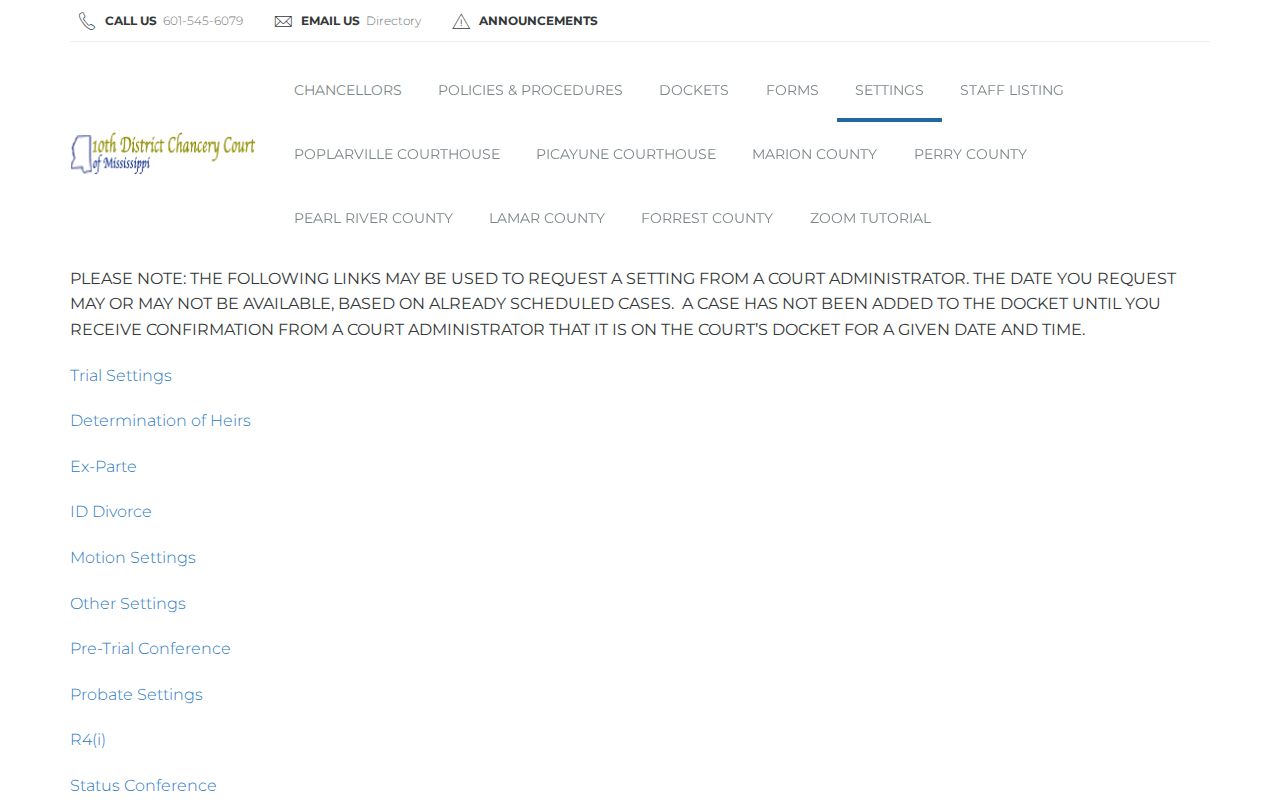
Those categories let a party figure out what kind of Chancery setting to request before calling the assigned court staff.
Perry County Court Date Lookups
Go to the court that keeps the case. Check more than one current source. A full case number is the best identifier. Without it, a party name, case type, and filing year can drive an account-based docket lookup. Common names return multiple results. A represented party can also ask the attorney of record. The attorney can confirm the date and the type of setting.
- Identify the court from the case subject. Circuit handles felony and circuit civil matters; Chancery handles equity, family, probate, and related matters; Justice and municipal courts keep their own lower-court dates.
- For Circuit or Chancery, sign in to Mississippi Electronic Courts through a public PAMEC account and read the newest docket entry or notice of setting.
- Check the court’s current calendar source. The Twelfth Circuit posts separate criminal and civil routes, while Tenth Chancery publishes settings and calendar material by category and chancellor.
- Confirm a date by calling the responsible administrator or clerk, checking courthouse or courtroom postings and docket call if applicable, and asking the party’s attorney. Call when the appearance is today or imminent.
Justice Court and municipal cases start with the Justice Court Clerk or the city court named on the citation. Perry County posts no consolidated traffic or municipal lookup. One caution: a public account is read-only. It cannot request a reset or change a setting.
Perry County Chancery Settings Menu
The Tenth Chancery District menu covers a wide range. Options include Trial Settings, Determination of Heirs, Ex-Parte, ID Divorce, Motion Settings, Other Settings, Pre-Trial Conference, Probate Settings, R81, Status Conference, and Uncontested Adoption. Pick the category that fits. Pick the assigned chancellor and Perry as the filing county. Then supply the case number, case style, requested date range, and whatever details that category asks for.
Each form wants different things. A trial request asks for issues, days needed, setting preference, and county preference. Probate requests separate opening an estate, closing one, guardianship, and conservatorship. They ask about contest status and approval of accountings or expenditures. A Rule 81 request flags an initial filing, contempt, modification, a combination, or something else. Nothing is set until the administrator confirms a date and time.
The Tenth Chancery local rules direct attorneys and self-represented litigants to the website for settings. The administrator is the fallback when the site cannot provide one.
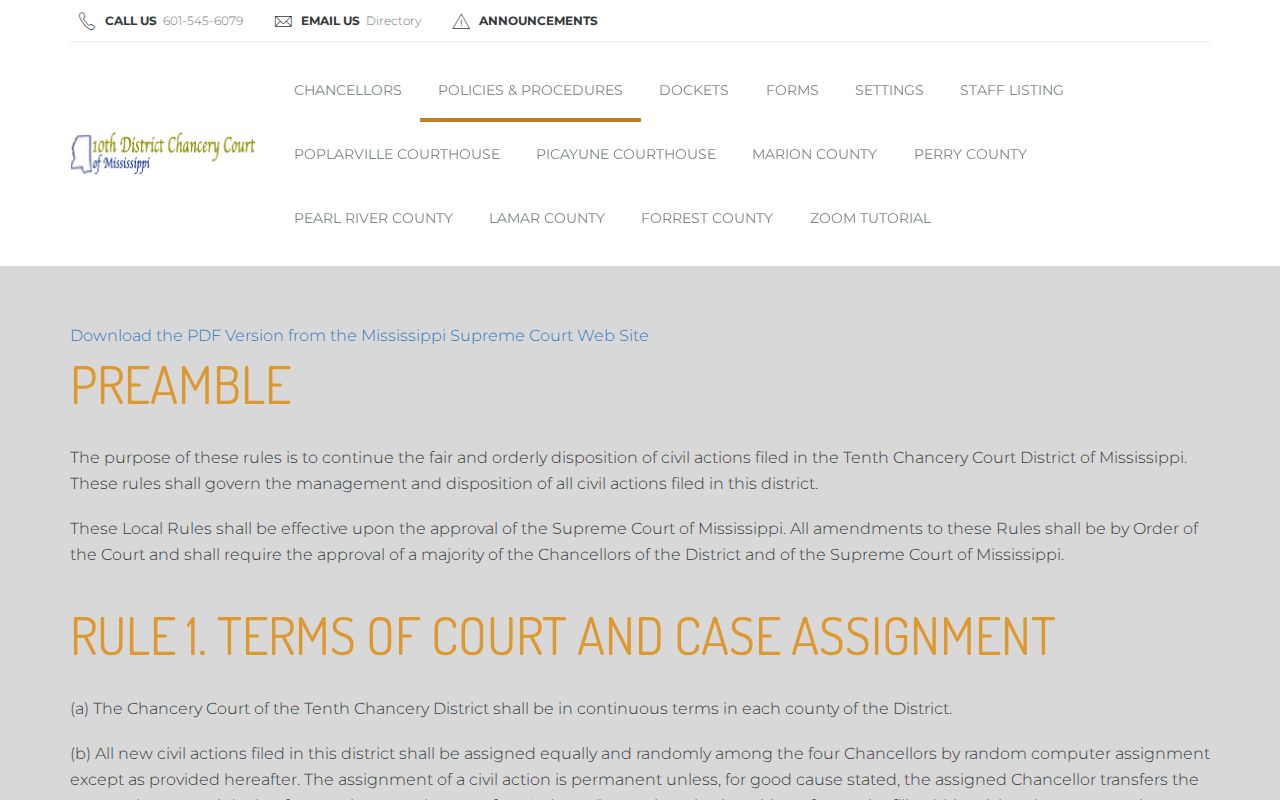
That local-rule route matters. Submitting an online form alone does not put a case on a Perry County calendar.
Court Settings: What Each Field Means
A setting is a scheduled court event. Read the calendar line and the docket sheet together. A Circuit MEC docket usually carries a case header, parties and counsel, chronological entries, setting notices, status or disposition material, and financial or judgment items. A published Chancery calendar adds fields for date, time, case number, case style, case type, judge, county, schedule text, docket text, comments, and attorneys.
| Date | The scheduled date shown in the most recent notice or docket entry. A later entry can replace an earlier date. |
|---|---|
| Time | The listed start time for the event. It may be a motion, docket call, or individual setting rather than a guarantee of hearing order. |
| Courtroom | Confirm this with the administrator or clerk when it is not shown. The inspected Chancery sample did not display a courtroom consistently. |
| Judge | The assigned Circuit judge or Chancery chancellor who is associated with the setting or calendar. |
| Setting type | The purpose of the event, such as trial, motion, probate, Rule 81 return, arraignment, hearing, or status conference. |
In a Chancery calendar, a docket-text line can name a hearing set for a specific date and time in Perry County before a chancellor. The case style gives the procedural caption. Schedule text flags a category, such as Motion Settings or an irreconcilable-differences divorce setting.
Perry County Circuit Calendar Routes
The Twelfth Circuit's criminal-calendar page offers no public search fields. For a date question, the page points you to Court Administrator Brittany Stuart at (601) 544-5495. The civil side works differently. Its page links out to a Civil Trial Calendar, Open Civil Trial Dates, and more. You also get Open Motion Hearing Dates and Set Motion Hearing Dates. Treat any open date with care. An open date simply means a slot is free. It does not mean a Perry County case has been placed there.
For current links, go straight to the Twelfth Circuit civil-calendar page. That page posts the live calendar links as the court updates them. That beats relying on an older saved PDF when you need a Perry County court date.
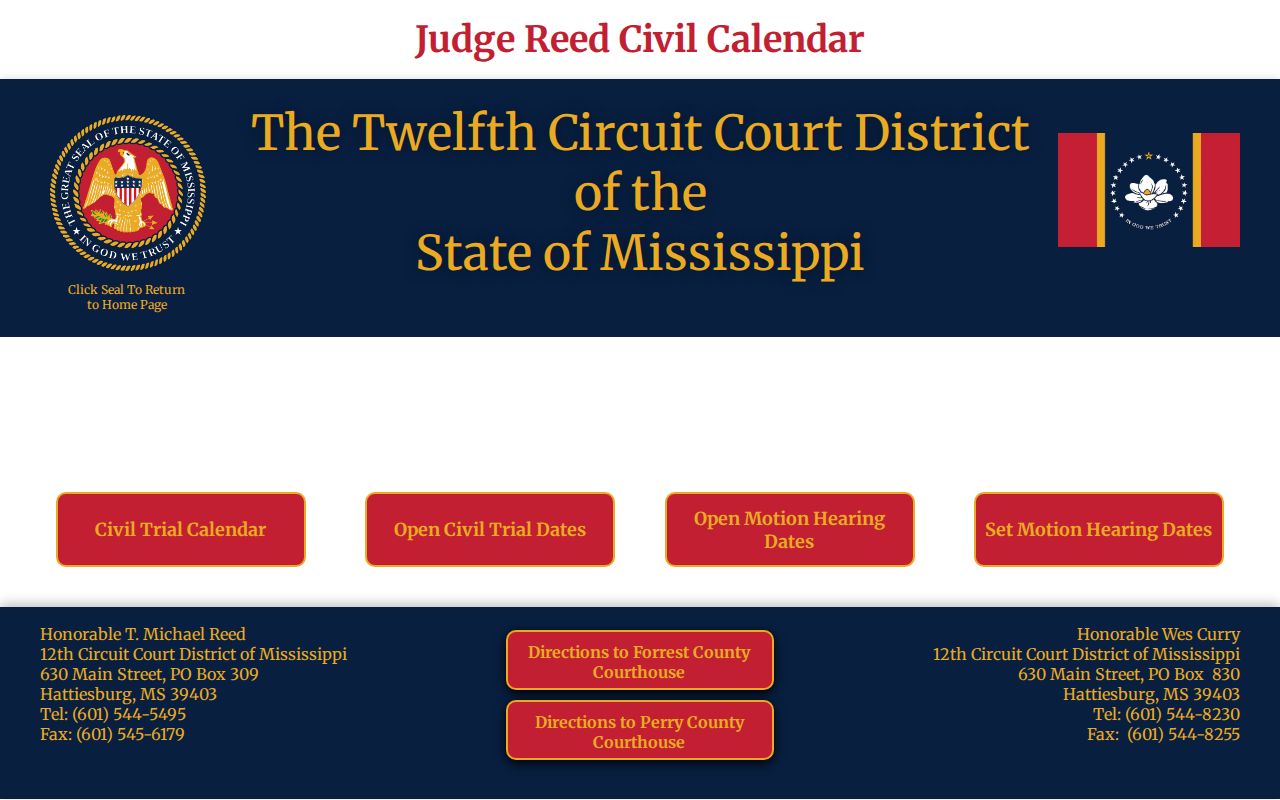
The Circuit splits its calendars by type, trial dates on one link and motion hearings on another. So a party should always confirm what kind of setting a published date represents before treating it as the next event in the case.
Perry County Monday Setting Practice
Tenth Chancery District policy puts most routine matters on Monday mornings at 9:00 a.m.: ex parte items, ID divorces, Rule 81 returns, and motions. The cap is 25 total settings per Monday morning unless the Chancellor allows more. Overflow settings can go at 1:30 p.m. That is the usual rhythm in Perry County, not a guarantee for any one case. The setting notice in your own case is what controls. Motions go to the staff attorney at least two weeks ahead when possible. Administrators generally will not set motions requested after Wednesday at 5:00 p.m. of the prior week. Ask through the real request route and wait for confirmation. Do not assume a Monday slot from the general practice alone. Note: A Rule 81 day-certain return date may be a required return but still not the final trial date in a contested case.
When a Court Date Moves
The vocabulary matters here. A setting request just asks for a date; it is not a confirmed court date. The notice of setting is the formal notice entered or sent once the date is confirmed. A continuance asks to move that setting. Tenth Chancery local rules require it by motion, granted or denied in the judge’s discretion. A reset is the new date scheduled after the old one has passed or been moved. Check in this order: the newest docket entry first. Then the current calendar page or PDF, then the court administrator, then the clerk. The newest confirmed notice beats an older calendar entry every time. An earlier date can sit in the docket history after a continuance. Its presence does not mean the hearing is still set. Perry County posts no separate holiday or weather-closure calendar. Confirm directly whenever an emergency is possible.
Perry County Setting Confirmation
When the public calendar is thin, a setting request is still pending, or a date has moved, the court administrator is the practical confirmation route. Tenth Chancery names its administrators and chancellor staff for exactly these setting questions. Under the local rules, the administrator e-files notice of a trial setting and mails notice by regular post to self-represented litigants who lack MEC access. That two-track notice process explains why an account view, a calendar PDF, and a phone confirmation may not match at the same moment. For contact details, the Tenth Chancery staff listing gives the district's court-administrator contacts for setting questions.
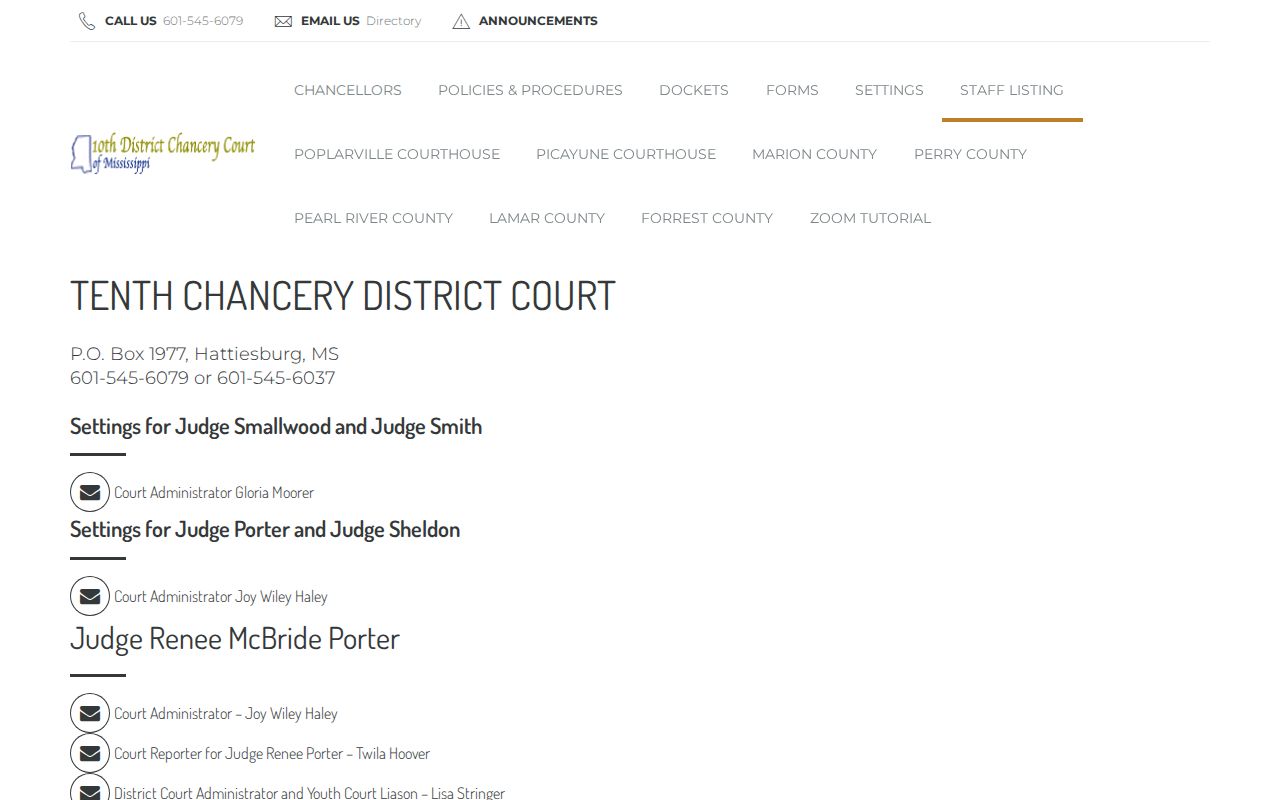
Circuit criminal settings work the same way in practice. The court publishes no public name-search calendar, so use the posted administrator contact rather than waiting for one.
Perry County Calendar Closure Checks
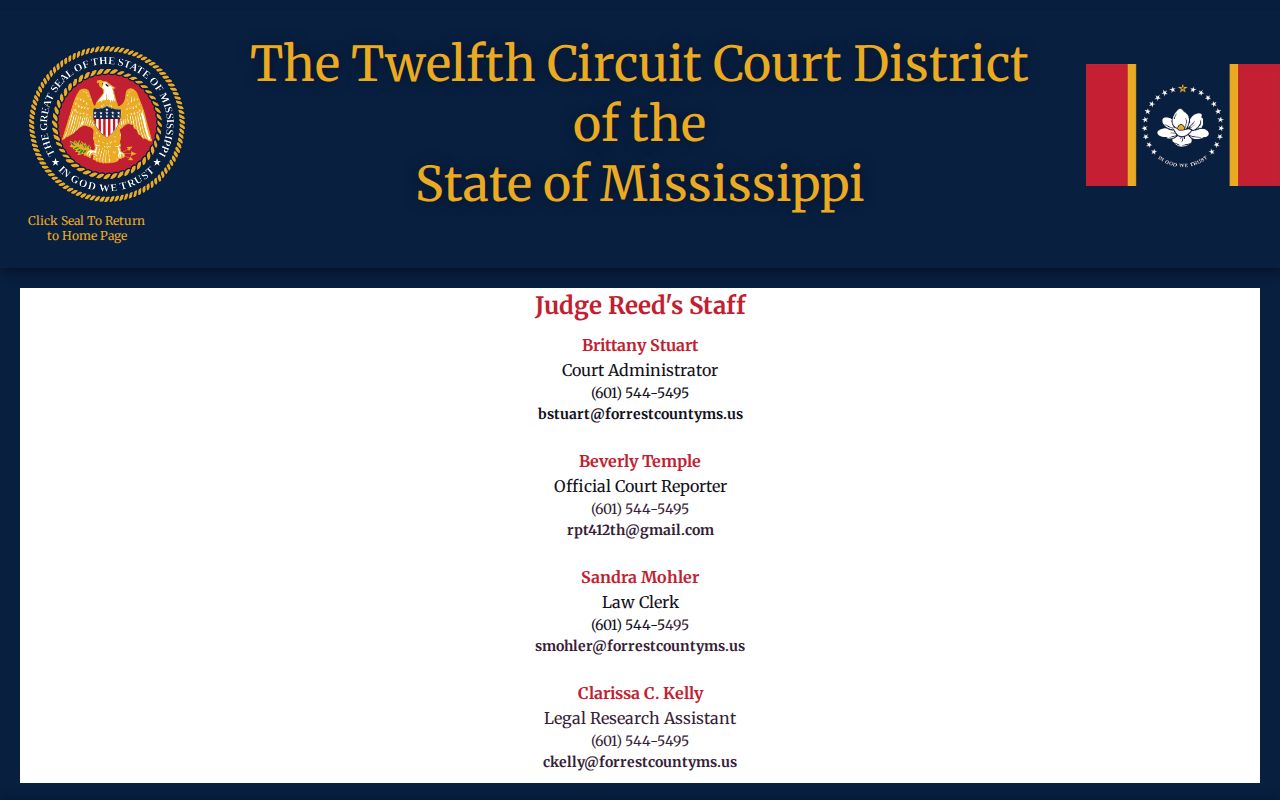
Perry County offers no dedicated holiday or weather-closure calendar through its courts. When an appearance date is near, scan the county and court websites for emergency notices first. Then call the administrator or clerk. The county Events page is not proof of anything here. It serves a broader county-events function. It does not show whether court is open or whether a setting exists. Another official source is the Twelfth Circuit staff-contacts page, which lists the Circuit administrator and related court staff.
Weather, a closure notice, or a same-day calendar change can all disrupt a Perry County appearance. When any of those is in play, a live phone call is the safer way to confirm.
Missed Settings and What Comes Next
Act quickly if a setting is missed. Start with the docket sheet and read the newest entry. Contact your attorney if one represents you, then call the administrator or clerk who keeps the case. Circuit felony matters can carry bond and appearance obligations, while a municipal or lower-court matter belongs with the court that issued the setting. Staff can confirm the current docket status for you. They cannot give legal advice.
Missed a Setting? A missed required court appearance can result in a failure-to-appear entry, a bench warrant, or other case consequences.
Contact the responsible court or attorney immediately to learn whether a new setting, motion, or other court action is required.
Seek advice from a licensed attorney about a missed Perry County court setting before deciding how to respond.
One more Circuit rule deserves attention. People released on felony bond must sign in monthly, from the first day through the second Wednesday, under the Twelfth Circuit’s felony-bond procedure. Miss a sign-in and a bench warrant can follow.